
Building Stronger Bones, More Muscle, and a Healthier Body Composition
6-Minute Read; Woman’s Health; Exercise & Longevity
You already walk. Maybe you use the elliptical, take a fitness class, or lift a few light weights. You are exercising more than many people you know. So why isn’t your waistline shrinking? Why does maintaining muscle suddenly seem harder? Is all that activity actually protecting your bones?
These are questions I hear frequently from peri-menopausal and menopausal ladies in our practice. Exercise after menopause needs to look different. The answer usually isn’t simply to exercise more. It is to exercise differently.
After menopause, maintaining bone and muscle requires your body to experience meaningful resistance. Doing more of the same is not be the answer.
Menopause Changes the Equation
Declining estrogen during menopause affects far more than your menstrual cycle. Bone loss accelerates, maintaining muscle becomes more difficult, and fat distribution tends to shift toward the abdomen. That abdominal, or visceral, fat matters because it is associated with insulin resistance, diabetes and cardiovascular disease.
Unfortunately, the exercise program that worked at 35 may not provide enough stimulus at 55. Walking and other cardiac exercises are important. I encourage it. But walking alone is usually not enough to maximize bone strength or preserve muscle. For those goals, your body needs something else: load.
For Your Bones, Intensity Matters
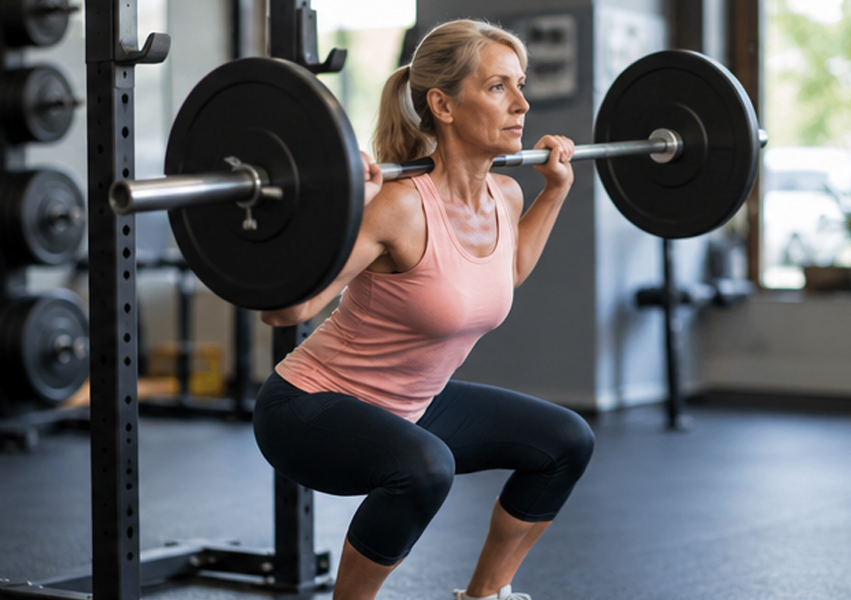
One of my favorite studies demonstrating this is the LIFTMOR trial. Researchers studied postmenopausal women who already had low bone density. Instead of prescribing tiny dumbbells and gentle exercise because their bones were fragile, one group performed supervised heavy resistance and impact training. The program was surprisingly simple consisting of 30 minutes, twice a week of heavy lifting.
These ladies did exercises such as squats and deadlifts performed for five sets of five repetitions and supervised impact training. After eight months, the women doing the high-intensity program improved bone density at important sites and became stronger and more physically capable. Equally important, the program demonstrated that appropriately screened women with low bone density can perform challenging resistance exercise safely when it is taught and supervised properly.
For Weight, Stop Letting the Scale Tell the Whole Story
Here we need to set realistic expectations. Exercise by itself usually produces fairly modest weight loss. A recent analysis of aerobic exercise trials in postmenopausal women with overweight or obesity found an average weight reduction of only about 2 kilograms. That can sound disappointing, until we look where the weight loss occurred.
A large analysis of 101 exercise studies involving nearly 5,700 postmenopausal women found that exercise reduced the critical visceral fat and body-fat percentage while increasing muscle mass. Imagine losing five pounds of fat while gaining three pounds of muscle. Your bathroom scale reports a rather unimpressive two-pound weight loss. But your body has changed substantially.
This is why I frequently encourage patients to track waist circumference, strength, clothing fit and body composition, rather than allowing a single number on the scale to define success. Aerobic exercise appears particularly helpful for reducing fat, while resistance exercise is particularly important for maintaining or gaining muscle. Combining the two is likely the best overall strategy.
Higher-intensity interval training can also be useful. Trials in postmenopausal women have shown reductions in abdominal and visceral fat with interval training, sometimes with considerably shorter workouts than traditional steady-state exercise.
There Is a Catch When Losing Weight
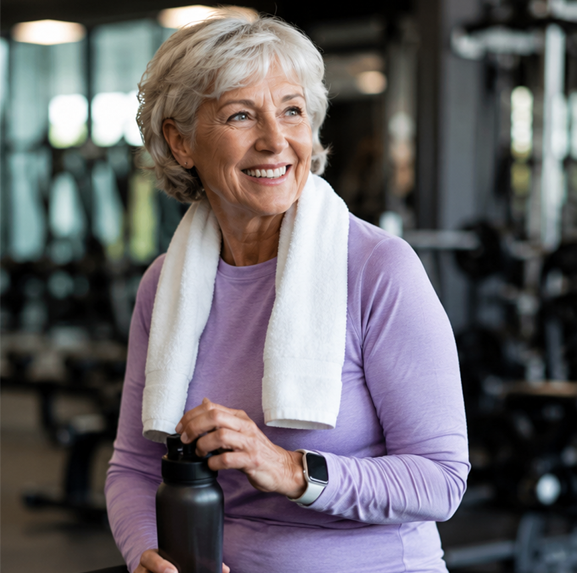
This becomes especially important for women actively trying to lose weight. When we lose substantial amounts of weight, we don’t necessarily lose only fat. Without the right stimulus, we can lose muscle and bone too. That matters whether weight loss comes from calorie restriction, lifestyle changes, or modern weight-loss medications (like GLP1 medications).
Research in older adults shows that resistance exercise during weight loss can help preserve lean tissue and may reduce the loss of bone density compared with relying primarily on aerobic exercise. So if your goal is significant fat loss, strength training should be part of the weight-loss prescription itself.
What Exercise after Menopause Can Look Like
There is no single perfect exercise program, but a useful framework for many healthy postmenopausal women might include:
Two or more days of progressive resistance training.
Prioritize large movements involving the legs, hips, back and upper body. Squats, deadlift variations, presses, rows and similar movements can be modified for nearly any starting fitness level. The goal is to lift a weight 5 times with good form and honestly couldn’t do a 7th or 8th. This is the “5-rep rule”. Remember you earn the weight, don’t start with heavy weight. Initially you will need to learn the movement or form, then can start progressively and safely add weight. The LIFTMOR study showed excellent safety when ladies learned technique first and built gradually from there. Safety and avoidance of injury is of paramount importance.
Some carefully introduced impact exercise.
Jumping, hopping and similar movements provide a different skeletal stimulus than resistance training alone. We call this axial loading and when done properly can offer significant improvement in bone strength.
Regular aerobic exercise.
Your classic walking, cycling, swimming and similar activities remain tremendously valuable for cardiovascular and metabolic health. Continue to aim for several sessions of this per week.
Some higher-intensity cardiovascular work.
Intervals do not need to occupy an entire workout. Short periods of harder effort on a bike, treadmill, hill or other modality can provide a potent cardiovascular stimulus.
The goal is not to make every workout exhausting, but there needs to be some stress to the bones and muscles in all of your workouts.
How Should You Measure Progress?
Many medical and fitness offices use bioelectrical impedance analysis (BIA) devices to estimate muscle mass and body fat. These devices are quick, inexpensive and useful estimates. Hydration, food intake, recent exercise and the particular machine being used can all affect the result. Studies comparing BIA with DXA scanning have found substantial differences in an individual person.
If you use BIA, try to measure under similar conditions each time: same machine, similar time of day and similar hydration status. Pay more attention to the direction of change over several months than whether today’s machine says your body fat is 31% or 34%.
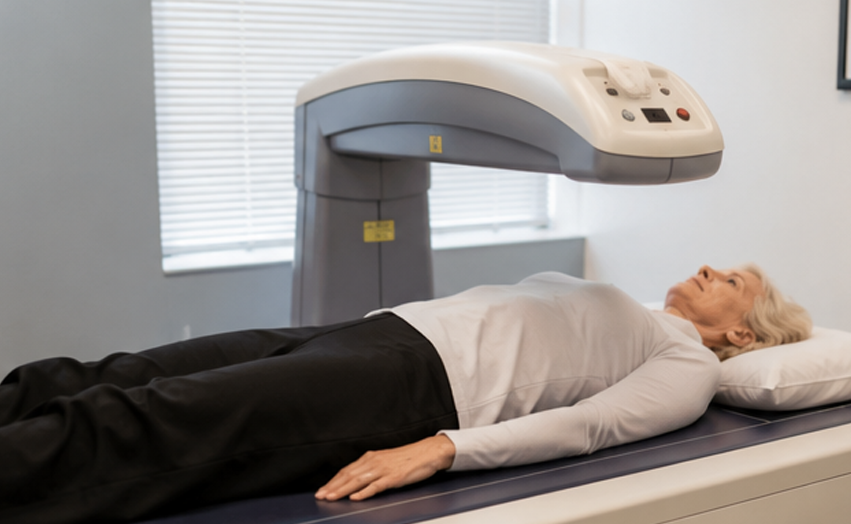
A DXA scan provides considerably more information. In our office we work with DXA scan providers in the area to give us the gold standard in biometric information. This information combined with exercise changes can help us understand how much muscle mass you really are gaining and how much fat loss is occurring.
The Goal Isn’t Simply to Be Smaller
Menopause doesn’t have to mean that weight gain, muscle loss and declining bone density are inevitable. It does mean that the way you exercise may need to change.
Walk. Cycle. Garden. Play pickleball. Do the activities you enjoy. But also give your muscles and bones a reason to remain strong. For many women after menopause, the next step isn’t spending another hour exercising. It’s making some of those minutes more purposeful, progressively harder, and strong enough to create adaptation.
If you have osteoporosis, a history of fractures, significant joint disease, or simply have never performed resistance or higher-intensity exercise, that doesn’t mean these types of exercise are off limits. It means we need to develop a safe starting point and progress from there.
This is also an area where our concierge model of medicine can discuss exercise after menopause in a more personal manner. Traditional medical visits are often built around addressing an immediate problem in a limited amount of time. We have the time and resources to focus on what comes next: reviewing your bone and body composition data, discussing nutrition and medications when appropriate, developing an exercise strategy around your current abilities, and then following your progress over time.
There isn’t a stack of paperwork or a generic exercise handout that works for everyone. The goal is to understand your starting point and build a plan that makes sense for your health, goals and lifestyle.
For women in the St. Louis area, our concierge practice gives us the time to look beyond the scale—evaluating bone health, body composition, nutrition, medications and exercise—and develop a plan around your individual goals.
The goal isn’t simply to weigh less. It is to build a body that remains strong, capable and metabolically healthy for the decades ahead.